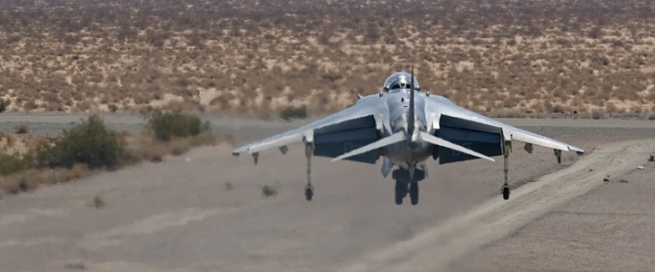
The pilot of the US Marine Corps AV-8B Harrier makes his approach for his first carrier landing of the morning. A bright blue sky above and an "ocean" of sun-baked desert below frame his horizon, for this airman is not at sea but in the middle of the unforgiving Sonora desert, home to Marine Corp Air Station (MCAS) Yuma, Arizona.
He is training with his deadly bird at Yuma’s AUX-II, an auxiliary landing strip in the Arizona desert. The strip has a tower made from scaffolding and a surface of AM-2 matting with the same layout and markings as the deck of a US Navy amphibious assault ship – a frequent home to USMC Harrier pilots
Marine Corps squadron VMA-211, currently stationed at Yuma, is conducting field carrier landing practice (FCLP) before embarking on the amphibious assault ship USS Tarawa, LHA-1. Before departing aboard their floating home, the Harrier pilots need to complete eight vertical landings. FCLPs are a prerequisite before heading out to "The Boat." Every landing is scrutinized closely by the landing safety officer, or LSO, and the commander of VMA-211, Lt. Col. Eric Austin.
The Harriers make their approaches and landings on the desert deck the same way as they would if landing on the Boat in any ocean or sea near a current world hotspot. They approach the AM-2 matting adorned with big, broad yellow stripes from abeam the "ship." This prevents the Harrier’s exhaust blast from kicking up sand and rock, which might cover the deck with FOD. The pilot slides his aircraft over to the "tram line" as only a Harrier can do. He then follows the tower’s lights and the LSO’s instructions to return his craft to Earth.
Guided by Flight Deck Officer (FDO), the Harrier then taxis up the tram to the departing point. The FDO performs a visual nozzle check, and signals the pilot to begin the launch procedure. The Harrier powers up, and after a salute from the pilot, the FDO gives the "go" sign. The aircraft accelerates for a short take off and jumps into the air. It will fly around to the landing point to repeat the sequence.
Unlike a real ship, AUX-II cannot maneuver into the wind, which would assist the pilots with lift for landings and takeoffs. Instead they must maneuver with a crosswind running across the landlocked carrier's deck.
Just as in any Marine Corps air operations, safety is paramount. The desert deck is manned by VMA-211 Plane Captain Sgt. Kincaid and his crew of enlisted men, plus a detachment of fuel personnel and aircraft firefighters. After several practice landings, a Harrier will reach its minimum required amount of fuel, water, or both. The pilot will taxi to the refueling point for a top-up from the fuel personnel, then to a watering point to "Water up" for the vertical landings. (The Harrier use water injection to generate additional thrust in the hover).
The aircraft will continue the evolution until completing the necessary eight vertical landings. The highly-trained Harrier pilots will make short work out of their FCLP and will be back at the MCAS before noon to debrief and prepare to head out to the Boat in a few short days.


 Support us!

 Articles
 Forums
 Airshows
 Profiles
 Links
Links Search
 Shop
Shop